
Your eyes are constantly working.
From scrolling on your phone to sitting in front of a computer, driving on sunny days, and even simply moving through indoor lighting, your eyes are exposed to light from morning to night.
And research is finding that two compounds from the marigold flower, lutein and zeaxanthin, can help. These naturally occurring plant pigments help support healthy vision and nourish eye tissues.
So, what exactly are lutein and zeaxanthin, and why are they often taken together?
Key Takeaways
- Lutein and zeaxanthin are plant pigments called xanthophylls found in foods like leafy greens and egg yolks.
- Both compounds help support the macula and retina, two important structures involved in healthy vision.*
- Lutein and zeaxanthin help support eyes exposed to blue light and ultraviolet (UV) light from sunlight, screens, and other light sources.*
- Their antioxidant action helps protect eye cells from oxidative stress caused by free radicals.*
- Many eye health experts recommend getting both lutein and zeaxanthin rather than relying on one alone.
What are lutein and zeaxanthin?
Lutein and zeaxanthin are naturally occurring plant compounds known as xanthophylls, a subgroup of carotenoids.
These yellow-orange pigments are found in colorful foods, such as:
- Egg yolks
- Kale
- Spinach
- Broccoli
- Corn
While leafy greens look green because of their chlorophyll content, they also contain significant amounts of lutein and zeaxanthin. The green color simply masks the yellow pigments underneath.
What makes lutein and zeaxanthin especially interesting is where they accumulate in the body. Unlike most plant compounds, lutein and zeaxanthin concentrate in the retina and macula of the eye, where they help support healthy visual function and eye tissue. In fact, they are the dominant carotenoids found in the macula, which is one reason researchers have become so interested in their role in vision and eye health.
Why do your eyes need lutein and zeaxanthin?
Because your body doesn't produce lutein or zeaxanthin on its own, they must come from food or supplements. Together, they support two important parts of the eye.
They help support the retina
The retina is the light-sensing layer at the back of the eye. It captures visual information and sends signals to the brain.
Both lutein and zeaxanthin help support healthy retinal tissue and healthy retinal cells.*
They help support the macula
The macula sits at the center of the retina and is responsible for sharp, detailed vision.
Reading, recognizing faces, driving, and many other visual tasks depend on the macula.
Lutein and zeaxanthin form much of the eye's macular pigment, which is why they are often studied together rather than separately. Their presence in this important visual structure helps support macular health and healthy visual function.
How do lutein and zeaxanthin work?
Lutein and zeaxanthin are unusual among plant compounds because they don't just pass through the body. Researchers have found that they become concentrated in the macula, a small area near the center of the retina that helps support sharp, detailed vision.
They become part of the eye's macular pigment
The macula contains a naturally occurring yellow pigment known as macular pigment. This pigment is made primarily from lutein and zeaxanthin. Researchers actually study these compounds in the eye by measuring macular pigment optical density (MPOD), which reflects the concentration of lutein and zeaxanthin in the macula.
They help support eyes exposed to light
Your eyes are regularly exposed to blue light and ultraviolet (UV) light from sunlight, screens, and everyday lighting environments.
Researchers report that lutein and zeaxanthin act as a natural filter that helps protect the retina and macula that are regularly exposed to incoming light.
They provide antioxidant support
Light exposure can generate free radicals within the eye.
Lutein and zeaxanthin have antioxidant action that helps neutralize free radicals and protect eye cells from oxidative stress.*
Why take lutein and zeaxanthin together?
This is one of the most important questions consumers ask.
Some people assume they should choose between lutein and zeaxanthin. In reality, you need both.
Although they are often discussed together, lutein and zeaxanthin are not identical compounds. Scientists have found that they're distributed somewhat differently within the macula, suggesting they may play complementary roles in supporting healthy vision. That's one reason most eye-health research studies both compounds together rather than focusing on just one.
The importance of the 5:1 ratio
Foods such as leafy greens and egg yolks naturally provide lutein and zeaxanthin together, often in roughly a 5:1 ratio.
This food-first perspective inspired New Chapter's formula, which delivers:
- 10 mg lutein
- 2 mg zeaxanthin
These specific amounts also match the 10 mg lutein and 2 mg zeaxanthin combination used in several clinical studies.
What should you look for in a lutein and zeaxanthin supplement?
Not all eye health supplements are created equally. Here are three things to consider as you're checking out the options.
Both lutein and zeaxanthin
Look for a formula that provides both compounds, not just one. That's because both are needed to support retinal and macular health. So, a combined formula can provide broader support.
Quality sourcing and extraction
Sourcing matters. For example, New Chapter's premium quality lutein and zeaxanthin come from marigold flower extract. They are concentrated using a gentler ethanol-based extraction process rather than typical hexane extraction.
The result is a thoughtfully sourced formula that aligns with New Chapter's whole-food-inspired philosophy.
Testing and verification
Eye health supplements should also undergo rigorous quality testing to confirm identity, strength, and composition.
A closer look: New Chapter Lutein + Zeaxanthin Eye Support
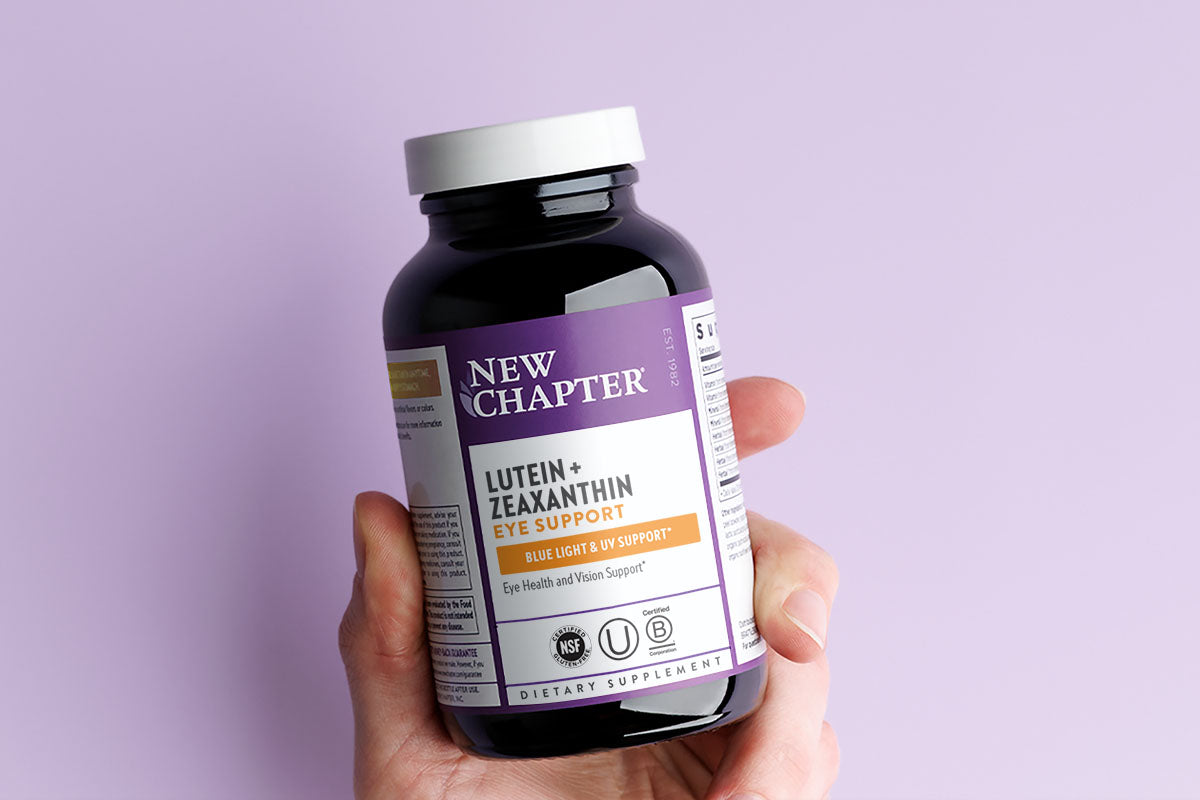
Because lutein and zeaxanthin play complementary roles in the eye, New Chapter Lutein + Zeaxanthin Eye Support provides both compounds from marigold flower.
Each vegan capsule delivers 10 mg lutein and 2 mg zeaxanthin, matching the ratio found in whole foods and the amounts used in eye-health research. The formula is also rigorously tested to help ensure quality, identity, strength, and composition.
With just one capsule per day, Lutein + Zeaxanthin Eye Support helps support healthy retinal cells, healthy visual function, eyes exposed to blue light and UV light, and protection against free radicals and oxidative stress.*
For people looking to nourish and support their vision every day, it's a simple way to bring two of the eye's most studied plant compounds into a daily routine.
The bottom line
Lutein and zeaxanthin are important eye-supportive plant compounds that can help you care for some of the most important structures involved in healthy vision.*
Because your eyes are working from the moment you wake up until the moment you go to sleep, giving them daily nutritional support may be one of the simplest ways to care for your long-term vision health. Lutein and zeaxanthin help you care for one of your body's most important senses, today and for years to come.